





Outcome Based Education (OBE)
Faculty, staff, and other stakeholders can use this handbook as a reference to better understand the Srinivasa Institute of Engineering and Technology College Outcome Based Education (OBE) approach. The handbook provides teachers with useful ideas for creating an assessment strategy that will measure students’ performance both during and after their academic careers. The method of creating a positive curriculum, content delivery, or teaching strategy is described in the handbook.
Currently, engineering institutes in India are rapidly implementing the Outcome-Based Education (OBE) approach. Improving technical education in India and enabling Indian engineers to compete with their international counterparts is regarded as a huge development. An essential demonstrative tool for student-centered learning that emphasizes using outcomes to gauge student achievement is outcome-based education, or OBE.
The goal of the quality assurance and improvement process is to ascertain whether the established learning goals satisfy a broad standard of quality. The outcome-based education (OBE) system places a strong emphasis on measuring students’ abilities, and one of its main pillars is their learning outcomes. The statements that outline the information and abilities a student should have at the conclusion of a course are known as course outcomes. The information, abilities, and attitudes that students should possess at the conclusion of the program are represented by the program outcomes. Course outcomes are a simple way to measure program outcomes. The Graduates Attributes (POs) are a set of criteria that form the foundation of the outcome-based education approach.
Abbreviations:
OBE | Outcome Based Education | BTL | Bloom’s Taxonomy Level |
|---|---|---|---|
LOT | Lower Order of Thinking | HOT | Higher Order of Thinking |
PEO | Program Educational Objectives | PO | Program Outcome |
CO | Course Outcome | PSO | Program Specific Outcome |
CE | Course Exit Survey | HoD | Head of Department |
PC | Program Coordinator | DAC | Department Advisory Committee |
PAC | Program Assessment Committee | AY | Academic Year |
OBE emphasizes what the Institute offers students and improves on conventional approaches. By creating or illustrating results utilizing “able to do” statements in support of pupils, it demonstrates success. OBE offers precise guidelines for quantifiable and verifiable results.
Accreditation serves to notify
- Informing parents and potential students that a program satisfies minimal requirements
- Employers that graduates are ready to start professional practice
- The public that graduates are conscious of societal considerations
- Faculty, HOD, Principal of a program’s strengths and weaknesses and of ways to improve the programme
Purpose of accreditation is NOT TO
- Identify the institution’s shortcomings while evaluating the performance status ante
- Disparage the institution’s and its programs’ methods of operation while offering feedback on their advantages and disadvantages
- Define the parameters of quality while providing a framework for raising awareness for ongoing enhancements to quality provisions.
- Choose only nationally renowned universities while identifying best practices and setting standards for excellence.
Benefits of Accreditation
- Facilitates continuous Quality Improvement
- Demonstrates accountability to the public
- Improves staff morale
- Recognizes the achievements/innovations
- Facilitates information sharing
- Priority in getting financial assistance helps the Institution to know its strengths, weaknesses and opportunities
- Initiates Institutions into innovative and modern methods of pedagogy
- Promotes intra and inter-Institutional interactions
Pre 2013 Scenario
- Metrics of educational excellence that concentrated on inputs, activities, and outputs, including classes taught, resources used, publications, placements, and graduate enrollments
- These metrics are not appropriate for informing governments, students, and the general public on the quality of teaching and learning since they do not quantify the extent to which higher education institutions genuinely enhance the knowledge and abilities of their students.
- Ratings and rankings are frequently employed as stand-ins for relative educational quality when there is a lack of comparable measurement of learning outcomes across institutions.
- There were no explicit indicators of learning quality, and the NBA criteria were primarily input-process-output linked.
Washington Accord
It recognizes the substantial equivalency of programs accredited by those bodies and recommends that graduates of programs accredited by any of the signatory bodies be recognized by the other bodies as having met the academic requirements for entry to the practice of engineering
The induction of India in the Washington Accord in 2014 with the permanent signatory status of The National Board of Accreditation (NBA) is considered a big leap forward for the higher education system in India. It means that an Engineering graduate from India can be employed in any one of the other countries who have signed the accord. For Indian Engineering Institutions to get accredited by NBA according to the pacts of the accord, it is compulsory that engineering institutions follow the Outcome Based Education (OBE) model. So, for an Engineering Institution to be accredited by NBA it should compulsorily follow the OBE model. Similarly, NAAC is also now following the same path and OBE is benchmarked as a standard for accreditation.
What are Outcomes?
- What a student should be able to do at the conclusion of a program, course, or instructional unit is an outcome of education.
- Outcome-based education is a method of teaching where curriculum choices are made based on the exit learning outcomes that students should demonstrate at the conclusion of the course.
- The skills that students gain at the conclusion of the program are known as outcomes.
- “Product defines process” in outcome-based education.
- It is the antithesis of input-based education, which places more focus on the educational process and is content with any outcome, and it is results-oriented thinking.
- Creating outcomes for an existing curriculum is only one aspect of outcome-based education.
A learning outcomes answers the question: “What is it that your students should be able to do at the end of the hour/lecture that they could not do before?”. It provides a clear guidance for the planning and development of the teaching process, including the design and organization of materials, the selection of the most appropriate teaching methods, as well as providing a measure for quality assurance (Biggs, 2003)
Some important aspects of the Outcome Based Education
1. A course is a theory, practical, or theory/practical subject that is studied over the course of a semester. For instance, engineering mathematics
2. Course Outcome (CO) At the conclusion of a course, students can consistently demonstrate that they have learned important and fundamental material. Generally, depending on each course’s weight, three or more course outcomes may be given.
3. A program is a degree’s area of specialty or discipline. It is the coordinated organization of classes, extracurricular activities, and co-curriculars to achieve preset goals that culminate in the granting of a degree. For instance, Marine Engineering B.E.
4. Results of the Program (POs) Program outcomes are more specific statements that outline the skills that students should possess by the time they graduate. It is anticipated that POs will closely correspond with Graduate Attributes.
5. Educational Objectives of the Program (PEOs) The statements that outline the expected career accomplishments of graduates, particularly those that are expected to occur in the initial years following graduation, are known as the program’s educational objectives.
6. Outcomes Particular to the Program (PSO) The skills that students should possess upon graduation in relation to a particular field are known as program-specific outcomes. A program typically has two to four PSOs.
FOUR PRINCIPLES IN OBE
The most widely used one is the four principles suggested by Dr. William Spady in the year 1994.
 Dr. William Spady is considered as the father of OBE
CLARITY OF FOCUS
Clarity of focus, meaning that all activities (teaching, assessment, etc) are geared towards what we want students to demonstrate;
DESIGNING DOWN
Design down, meaning designing the curriculum from the point at which you want students to end up
HIGH EXPECTATIONS
** Establish high, challenging performance standards
** Engage deeply with issues are learning
EXPANDED OPPORTUNITES
** All students can be successful. Its only that they may require different instructional strategies
** Additional learning opportunities in order to do so
The Essentials of OBE- In OBE, what matters ultimately is not what is taught, but what is learned;
- Teachers must set appropriate course intended learning outcomes, instead of teaching
Objectives:
- Constructive alignment: What we teach, how we teach and how we assess ought to be aligned with the intended learning outcomes, such that they are fully consistent with each other
- The quality of teaching is to be judged by the quality of learning that takes place
- All OBE approaches take a criterion-based view of assessment and focus on what students can do with knowledge after a period of learning
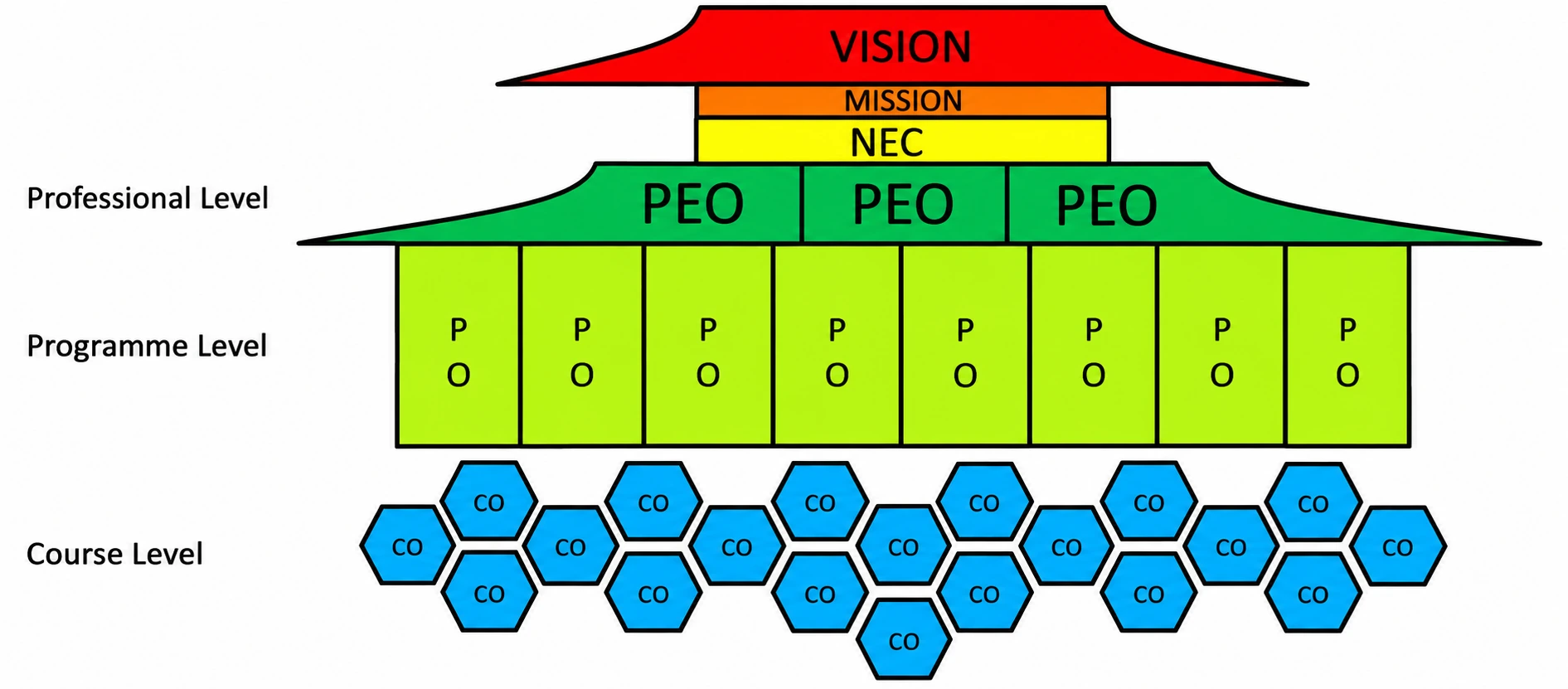
- Program Educational Objectives: PEOs are broad statements that describe the career and professional accomplishments in five years after graduation that the program is preparing graduates to achieve.
- Program Specific Outcomes: PSOs are statements that describe what the graduates of a specific engineering program should be able to do.
- Program Outcomes: POs are statements that describe what the students graduating from engineering programs should be able to do.
- Course Outcomes: COs are statements that describe what students should be able to do at the end of a course. The method of assessment of the candidates during the program is left. for the institution to decide. The various assessment tools for measuring Course Outcomes include Mid -Semester and End Semester Examinations, Tutorials, Assignments, Project work, Labs, Presentations, Employer/Alumni Feedback, etc,
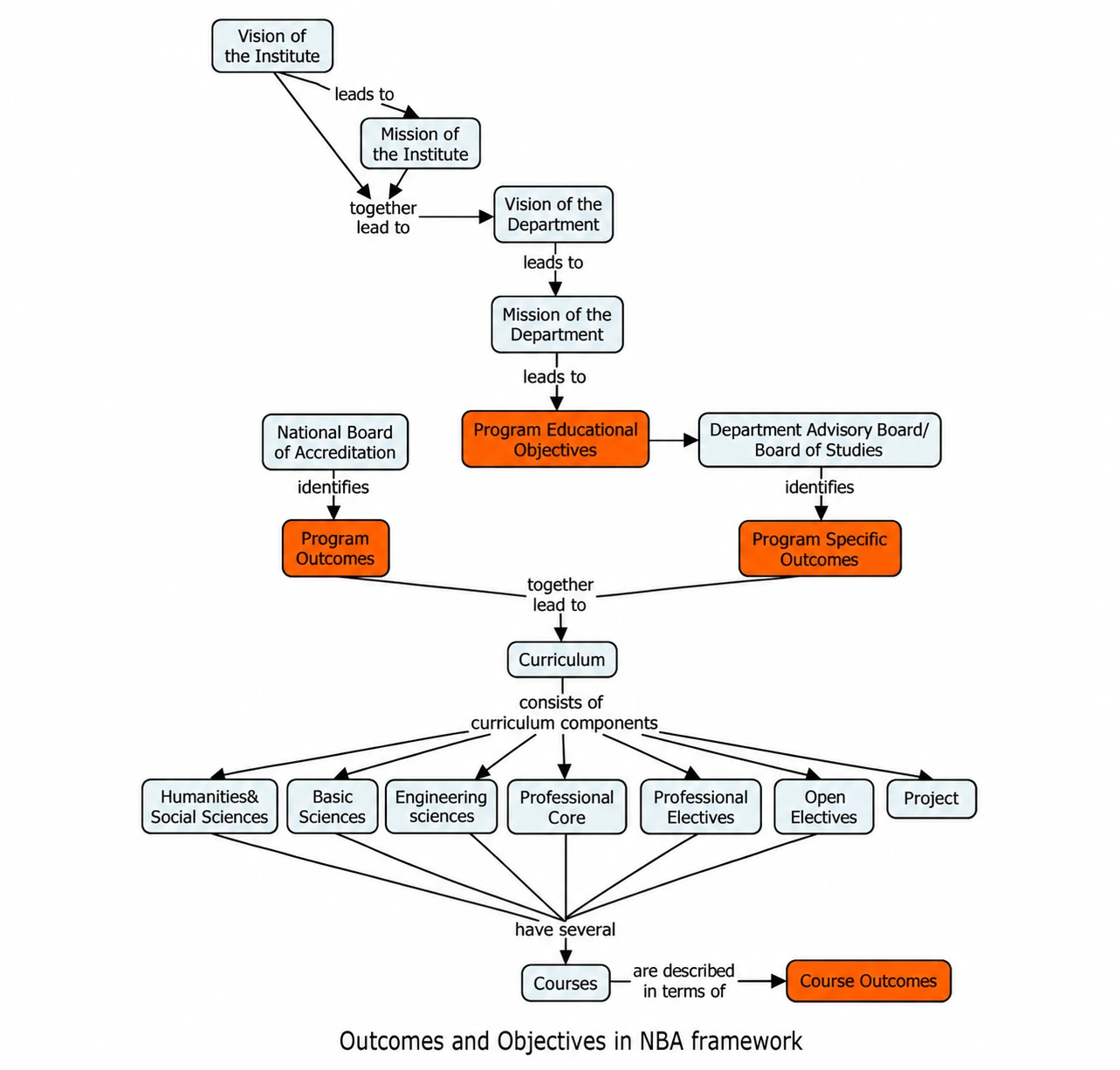 PROGRAM OUTCOME (PO) are descriptions of the qualities, skills, abilities and understandings, an institutional community agrees that its students should develop as a consequence of the learning they engage with the program of study in that institution. POs indicate what students are expected to know and be able to do by the time they graduate from the institution. POs are not directly connected to any specific academic disciplines. Students join an institution from different backgrounds, cultures and experiences. While studying at the institution, we want them to broaden their horizon and attitudes, and to develop their current skills and abilities and learn new ones. This is expected not only to help them in their studies and future careers, but also to support their role within society. POs also reflect the Vision, Mission and Core Values of the institution. POs are not simply taught but developed through meaningful experiences and the processes of learning and reflection. They are unique to every student, yet might be able to identify some common areas that the institution wants their students to develop. Students will have their own starting points, progress and experiences in these areas while at the institution which will shape them as individuals
- Engineering Knowledge
- Problem Analysis
- Design and Development of Solutions
- Conduct Investigations on Complex Problems
- Modern Tool Usage 6. The Engineer and Society
- Environment and Sustainability
- Ethics 9. Individual and Team Work
- Communication
- Project Management and Finance
- Life-Long Learning
PROGRAM SPECIFIC OUTCOME:
PSOs are statements that describe what the graduates of a specific engineering program should be able to do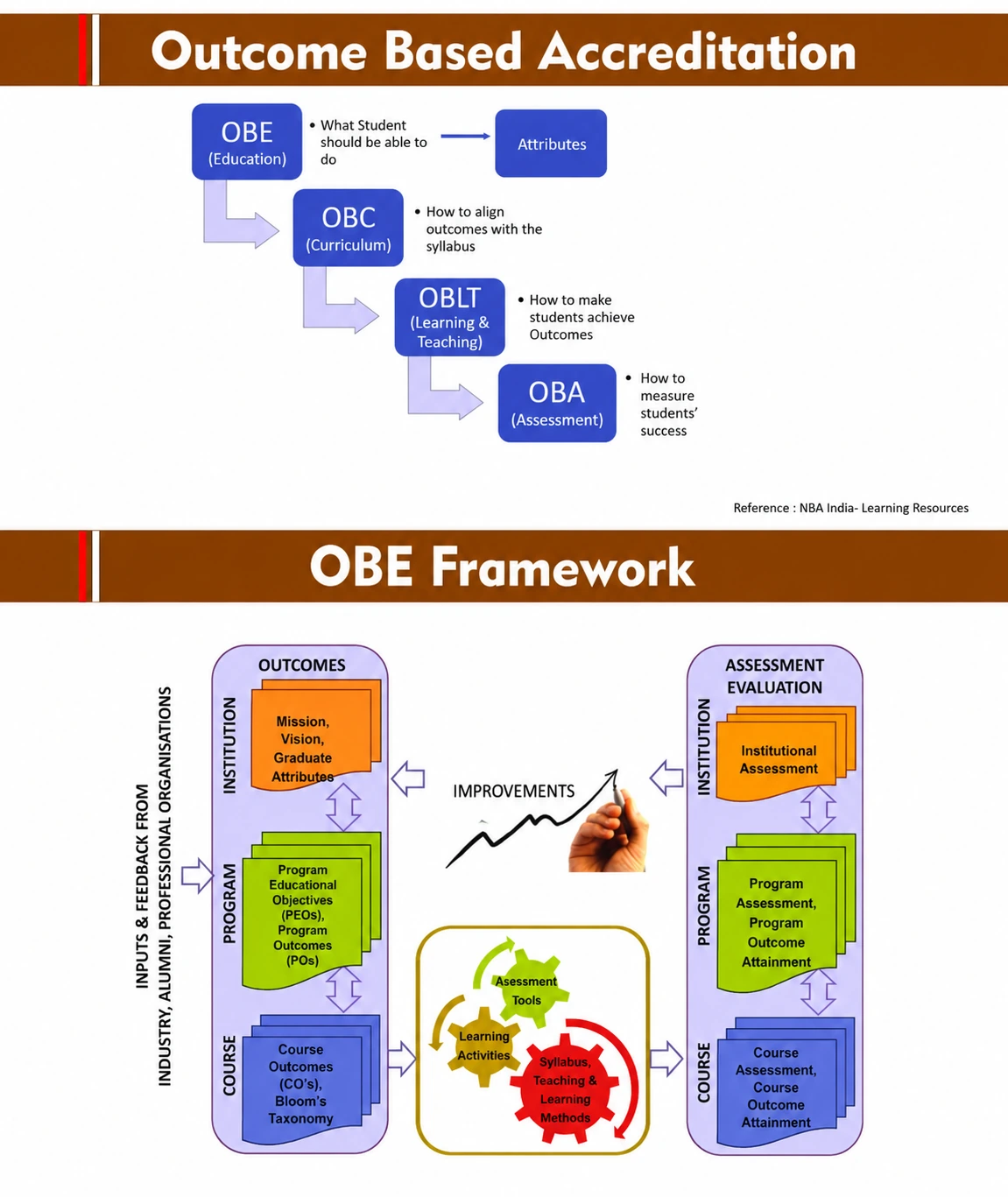 Traditional vs the Outcome-based Approach: The traditional way of teaching was where the teacher instructs the students and the students generally take down the notes without even logical thinking. The important thing regarding teaching in the traditional method is that topic is written on the blackboard and students take down notes from the blackboard as a result at the end of the day the students memorize the same and appear for the examination with the at most intention to pass the Examination. With the recent advancement, there is no point in adhering to the Traditional method as the competition towards has increased enormously. Outcome based education is seen a paradigm shift in the higher education that is student focused and outcome orientated. The table below provides a comparison of the traditional teaching approach and the outcome-based approach.
Administrative System for OBE:
Bloom’s Taxonomy:
Bloom’s Taxonomy provides an important framework to not only design curriculum and teaching methodologies but also to design appropriate examination questions belonging to various cognitive levels. Bloom’s Taxonomy of Educational Objectives developed in 1956 by Benjamin Bloom was widely accepted by educators for curriculum design and assessment. In 2001, Anderson and Krathwohl modified Bloom’s Taxonomy to make it relevant to the present-day requirements. It attempts to divide learning into three types of domains (cognitive, affective, and behavioural) and then defines the level of performance for each domain. Conscious efforts to map the curriculum and assessment to these levels can help the programs to aim for higher-level abilities which go beyond remembering or understanding, and require application, analysis, evaluation or creation. Revised Bloom’s taxonomy in the cognitive domain includes thinking, knowledge, and application of knowledge. It is a popular framework in engineering education to structure the assessment as it characterizes complexity and higher-order abilities. It identifies six levels of competencies within the cognitive domain as shown below which are appropriate for the purposes of engineering educators. The blooms taxonomy is shown in figure where the lower levels become foundation for the higher levels. The Bloom’s taxonomy process is ordered in such a way that the lowest level is the simplest form of recognition, while the highest level built on lower levels involves more complex form of cognitive skill. By providing a hierarchy of levels, this taxonomy can assist teachers in designing assessment framework to measure the student’s learning ability and making teaching method, innovative and adaptive to student’s competencies and enhancing the same. Developed to provide a common language for teachers to discuss and exchange learning and assessment methods. It is a hierarchical model used to classify educational learning objectives into levels of complexity and specificityThe cognitive process dimensions- categories | |||||
Lower Order of Thinking (LOT) | Higher Order of Thinking (HOT) | ||||
Remember | Understand | Apply | Analyse | Evaluate | Create |
Recognizing (identifying) Recalling (retrieving) | Interpreting Illustrating Classifying Summarizing Inferring (concluding) Comparing Explaining | Executing Implementing | Differentiating Organizing Attributing | Checking (coordinating, detecting, testing, monitoring) Critiquing (judging) | Planning Generating Producing (constructing) |