
Governance
Governing Body
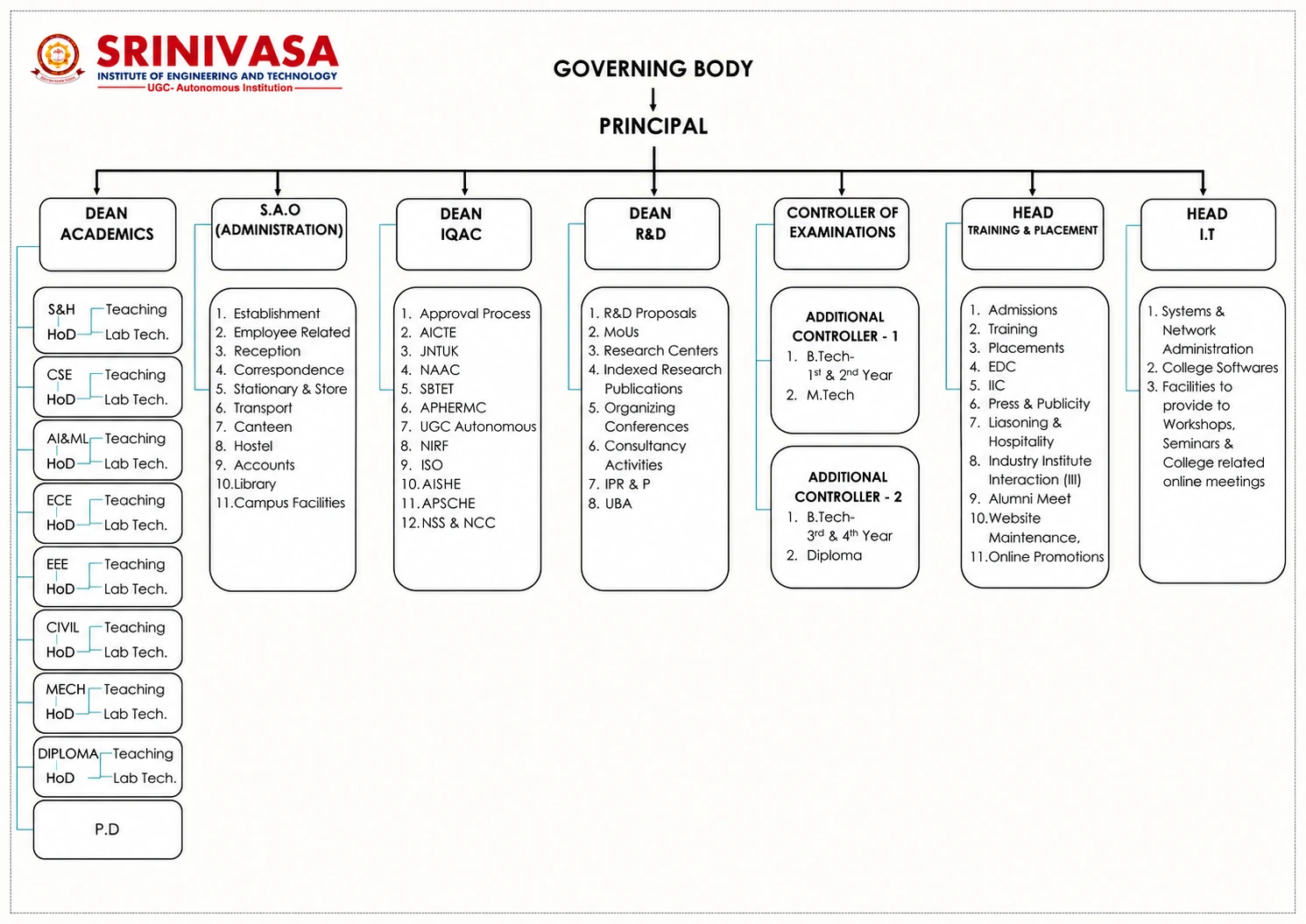
Srinivasa Institute of Engineering & Technology is governed by highly qualified and experienced persons from various walks of life. It consists of industrialists, educationalists, prominent scientists, HR Professionals, philanthropists, infrastructure developers and important people from society.
Sri S V S S Ramachandra Raju
Chairman, Sri Saraswathi Educational Society
Chairman
Sri D.V.N.S. Varma
Secretary & Correspondent, Sri Saraswathi Educational Society
Member (Management Nominee)
Sri M V S S Ramachandra Raju
Entrepreneur
Member (Management Nominee)
Sri D.V.R.P. Raju
Industrialist
Member (Management Nominee)
Sri A.V.Ramana Raju
Industrialist
Member (Management Nominee)
Sri S.Vasudeva Rao
Chairman & Managing Director, Triton Buildings & Structures Pvt. Ltd., Hyd.
Member (Management Nominee)
Prof. G.S.N.Raju
Chancellor, Centurion University, Rollavaka , Bondapalli, Vizianagaram
Member (Educationalist)
Dr D.R. Prasada Raju
Former Scientist, Dept. of Science & Technology, Govt. of India, New Delhi
Member (Educationalist)
Sri V. Nageswara Rao
Principal, Dr.B R Ambedkar & GMR Polytechnic College, Rajahmundry
Member (AP State Govt. Nominee)
Dr. V.Ravindra
Director, R&D, JNTUK, Kakinada
Member (University Nominee)
Dr. B.Ratna Raju
Dean IQAC
Member (Faculty Nominee)
Dr Y.Venkat
Dean Research and Development
Member (Faculty Nominee)
Sri K.V.V.Bapi Raju
Vice Principal
Member Administrative staff of the college
Dr K.Suresh Babu
Principal, SIET
Member Secretary
Term
The Governing Body shall be reconstituted every five years.
Meetings
Meetings of the Governing Body shall be held at least once every six months.
Quorum
Presence of a minimum 50% of Members will be the quorum.
Functions of the Governing Body of an Autonomous College
Subject to the existing provisions in the bye-laws of the respective Autonomous College and the rules prescribed by the State Government/Parent University, the Governing Body shall:
Provide Strategic Guidance
Guide and oversee the college in achieving the objectives for which it has been granted autonomous status, ensuring academic excellence and holistic institutional development.
Approve Academic Programs
Approve the introduction of new academic programmes leading to degrees, diplomas, and certificates as recommended by the Academic Council, in line with national education policies and industry requirements.
Institute Academic Incentives
Sanction scholarships, fellowships, studentships, medals, awards, and certificates based on the recommendations of the Academic Council to encourage and support meritorious and deserving students.
Oversee Faculty Recruitment
Approve the recruitment of teaching faculty and the Principal in accordance with UGC, State Government norms, and reservation policies, ensuring transparency and merit-based selection.
Approve Financial Plans
Approve the annual budget, audited statements, and financial policies to ensure sound financial management and sustainability of the institution.
Ensure Statutory Compliance
Ensure compliance with statutory bodies like UGC, AICTE, and State Higher Education Councils, and regularly review audit reports and accreditation outcomes.
Review Institutional Performance
Monitor and evaluate the performance of the institution in academic, research, and administrative domains periodically and guide improvements.
Establish Sub-Committees
Constitute and empower sub-committees such as Finance Committee, Purchase Committee, and Infrastructure Committee for effective governance and decision-making.
Promote Innovation and Research
Facilitate the development of research centers, incubation hubs, industry collaborations, and skill development initiatives.
Approve Infrastructure Development
Approve plans for infrastructure expansion, digital infrastructure, and campus modernization in line with the institution’s strategic plan.
Foster Stakeholder Engagement
Promote active participation of alumni, industry experts, and community stakeholders in academic and institutional growth.
Adopt NEP 2020 Guidelines
Oversee the implementation of the National Education Policy 2020, including multidisciplinary education, Academic Bank of Credits, internships, and skill-oriented learning.
Promote Gender Equity and Inclusivity
Ensure policies are in place for inclusivity, gender equity, and environmental sustainability as part of good governance practices